One tuning issue I have seen come up again and again is the “early drop.” It is one of the biggest tuning mistakes people can make, and it is not restricted to just the Ant Rest—it can have varying negative effects no matter which rest you choose. This is the situation where the rest drops immediately at release and the arrow either passes through the rest low, or (if the arm has time to return) contact occurs later in the arrow’s passage. This usually corresponds with the need for an extremely low nocking point and creates a false weak bareshaft reaction, because the shaft travels medially and below the plunger without plunger guidance or resistance to shaft paradox. The result is inconsistent grouping and an impossible bareshaft spine search. On a non–drop-away rest, this issue typically shows up as an early bounce, the shaft passing high, poor crawls, and the need for a higher nocking point height.
The best tunes I have seen on my rest are the ones in which the arm barely moves at any point in the shot process. This is often contrary to what people believe the rest should do. I have had people complain that the magnets are too strong and that the rest is “not dropping,” but when they show video, the need for the drop is not even there. A good example is a 50m tune: you are not crawling enough at that distance to create meaningful downward forces on the rest, so if you are seeing them, I strongly suggest you look at your tune. Getting great crawls, first and foremost, depends on a tune that does not put a downward force on the rest until you reach your maximum crawls. A drop-away rest can be more forgiving with a proper tune, but it becomes a liability with a poor tune because it introduces the possibility of losing plunger guidance due to vertical shaft movement. The “magic” of a drop-away rest happens once a perfect tune is reached, and it is a goal worthy of accomplishing.
In helping many people with contact issues and bareshaft tuning problems, I have found that most of the time the culprit is an upper limb that is too strong (negative tiller), shafts that are too stiff, or a combination of the two. Tiller can seem like a minor detail, but when you consider that two of the main things affected by stringwalking are limb timing and effective stroke/spine, it becomes clear that these details can completely ruin your day. The ideal outcome is a tune where the middle of your crawl range is correct for the average distances that will score you the most points, while the outlying distances are only slight deviations. Of course, a drop-away rest can help by reducing and compressing crawls. I know the majority of barebow shooters use a negative tiller and this idea will often fall on dead ears, but I do ask you to truly analyze your tiller and whether it is actually best for you. The idea that you must use negative tiller when crawling makes sense for very deep crawls, but it is unnecessary for most shooters.
Here’s why. First, the bow’s vertical center is not at the nock of the arrow. If you measure your riser, you will likely find the grip throat is centered on the riser. Some risers, like Rossing and newer Hoyts and DAS have the grip center shifted down slightly, moving the bow center closer to the nock position (a good thing). Some older barebow risers, like the Best Zenit or Bernardini Luxor, have the grip shifted upward from center—another reason to check. Every manufacturer is different, and you should know where your bow’s center actually is. Start with even tiller on your bow for this example. Put a piece of tape at riser center, then measure your string’s vertical center and mark that as well. You will likely notice your nock is about 1.5″ above center. If you pull the string with fingers directly under the nock, you are already pulling the upper limb with more leverage than the lower because you are above center. This is already negative tiller. Now slide down to an average crawl of 1.25–1.75″ and you are at bow center with effectively even tiller. Slide to a deep crawl over 2″ and you are slightly positive tiller. With even tiller, you are already maximized for mid-distance crawls, and only slightly positive or negative for short and long crawls.
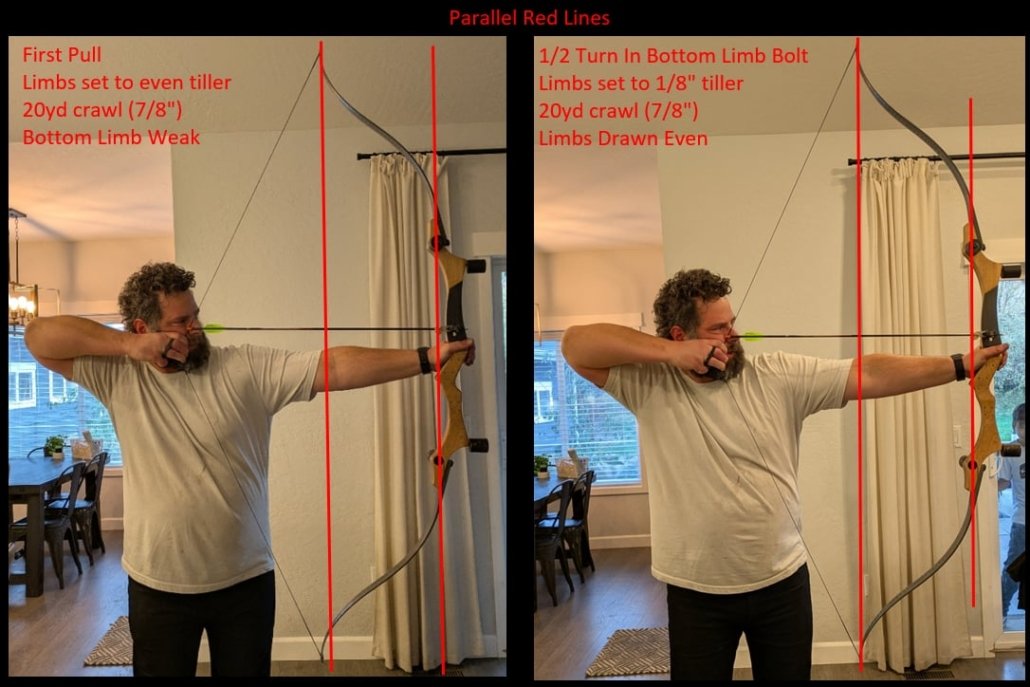
That said, your best tiller will still require effort to find. I highly recommend analyzing your tiller using the bow tuning guide on the Backwoods Composites website. Essentially, you want to make sure that at your ideal average crawl, the bow does not move into your palm or web while drawing. It should pull evenly and without excessive movement, wherever you prefer your grip pressure to be (a subject for another time). Tiller is something you should feel, and as a beginner it can feel abstract, but it is important feedback you need to build awareness around. We can measure tiller statically with a bow square while the bow is strung, but it is also helpful to analyze it at full draw, either with a draw board or by having someone take a side-profile photo (as photo below). Then, by drawing parallel reference lines between the riser and limb tips, it becomes very clear which limb is too strong or too weak. In the Backwoods Composite photo below, even with a 1″ crawl, positive tiller was needed to time the limbs correctly. To make things more complicated, these static measurements are only scratching the surface. What the limbs do when we actually let go of the string is the truest test.
So how does limb timing affect the rest, and specifically, how does it cause the early drop? We know that immediately at release, the point resists forward motion and the shaft must flex—meaning it must be flexible enough to cushion that initial impact. Now imagine the upper limb is too strong and you are using a medium crawl. Gravity is acting downward on the tip and the rest is supporting the shaft. When the string is released, the upper and lower limbs behave independently for a brief moment because the lower half of the string has not yet “caught up” to the nock. The upper limb already has a direct connection to the nock, but the lower limb is effectively dry-fired for a split second until the slack is taken out of the string. Immediately at release, the upper limb pulls up and forward on the nock. Because the nock is vertically above the point, this quick jerk from an overly strong upper limb increases loading on the point, which is resisting forward movement (this is why spine is so critical here). At the same time, the shaft is tilted upward at the tail. A drop-away rest has no choice but to collapse at this moment, which is exactly what we see in slow-motion video. Then, as the lower limb catches up, the shaft is thrown back into the rest—usually low through the plunger. One common indication is an unusually low nocking point height. On a non–drop-away rest, this same initial downward force instead produces bounce and a higher nocking point height.
Ultimately, the rest is only responding to what the arrow and tune are doing to it. Even the strongest magnetic arm can be bullied by a light poorly tuned arrow and bow. Going to a lighter drop is clearly not the solution. Blaming any rest, magnet strength, spring rebound, or similar factors for these phenomena is barking up the wrong tree.
Photo courtesy of Backwoods Composites Bow Tuning Guide